
AI and intellectual property: who owns what is created with AI?
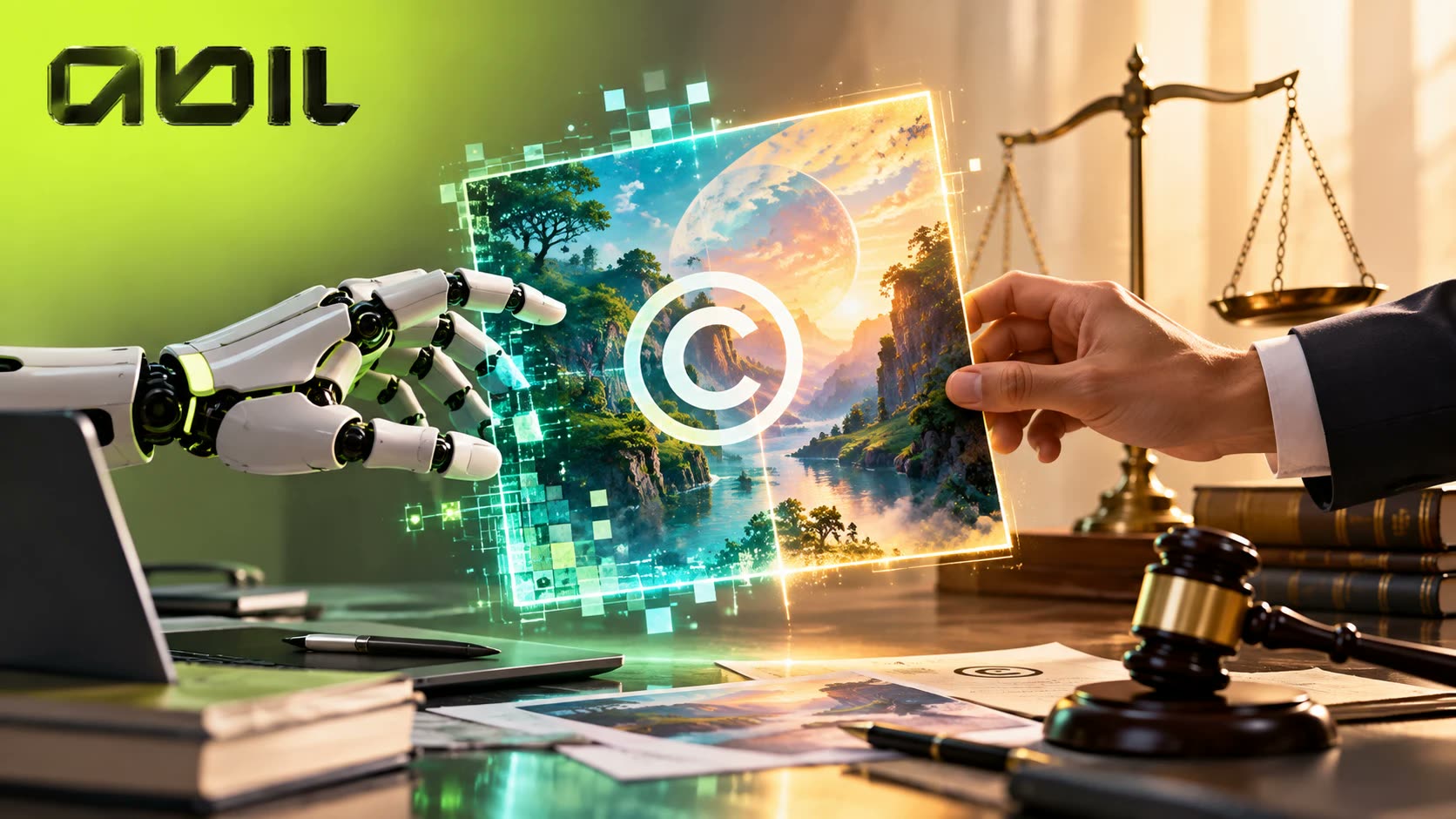
Copyright protects what a human designed, not what the machine generated on its own. What that changes for brands, their agencies and their contracts.
 Abil Medias Agence Publicité Genève
Managing partner
Does a campaign visual, a slogan, a video or an app created with AI belong to the agency, to the client, or to no one? The short answer: the law protects what humans put into it, not what the machine generated on its own.
For a communications agency, this is a very practical question. We transfer rights to our clients in the work we deliver. If part of that work is protected by no right at all, what are we actually transferring? And what can a brand do if a competitor reuses an AI-generated visual? Copyright was designed for human creators, and courts and lawmakers are still working out the consequences.
The principle: no copyright without a human author
Across the Western world, the same rule applies: only a natural person can be an author. An AI holds no rights, and what it produces on its own is protected by no one.
In France and the European Union, the Intellectual Property Code protects original works of the mind. French judges define originality as the imprint of the author’s personality, and the Court of Justice of the EU as “the author’s own intellectual creation”, resulting from free and creative choices. A machine has neither a personality nor creative choices in the legal sense. In 2023, a Prague court accordingly refused any protection to an AI-generated image.
In the United States, the question is settled. Researcher Stephen Thaler sought to register an image created autonomously by his AI system. The Copyright Office refused, the federal appeals court in Washington upheld that refusal in 2025, and the Supreme Court declined to hear the case on March 2, 2026 (Mayer Brown). In its January 2025 report, the Copyright Office states that prompts function as instructions conveying ideas, and ideas cannot be protected.
Elsewhere, there are nuances. Since 1988, the United Kingdom has protected “computer-generated” works for the benefit of the person who made the arrangements for their creation, a rule the government is considering abolishing. In China, a Beijing court recognized copyright in an AI-generated image in 2023, because the user had made numerous adjustments and choices.
The decisive criterion is therefore the same everywhere: the extent of human creativity.
Text, image, video: what is protected, format by format
The rule is the same for every format: what a human conceived, selected, wrote or modified is protected; what AI generated without human creative input is not. But each format raises its own questions.
Text: articles, taglines, slogans
A text written by a copywriter and then proofread, corrected or rephrased with AI remains their work. Conversely, an article produced from a single prompt and published as is belongs to no one.
- What is protected: the angle, the structure, the tone, the passages written or rewritten by the copywriter. According to the US Copyright Office, the selection and arrangement of generated content, or its substantial modification, can also be protected.
- Slogans: a slogan produced 100% by AI is not protected by copyright. Anyone, including a competitor, can reuse it. Only a trademark registration, possible if the slogan is distinctive, allows the brand to reserve its use.
- The hidden risk: a model can reproduce an existing text almost word for word. In 2025, a Munich court ruled that ChatGPT’s reproduction of song lyrics was copyright infringement. A plagiarism check before publication is essential.
- Transparency: the AI Act requires disclosure of AI-generated text published to inform the public on matters of public interest, unless it has been reviewed by a human who takes editorial responsibility for it. Human review therefore also protects you on this front.
Images: visuals, illustrations, logos
This is the most exposed format. An image straight out of a generator is not protected, even after hundreds of prompts.
- A prompt is not enough: in 2023, the Copyright Office refused to register Théâtre D’opéra Spatial, an award-winning image created by Jason Allen with Midjourney after 624 attempts. Only his own edits could have been protected. He has challenged the refusal in court.
- What is protected: substantial edits, the overall composition, the arrangement of images within a work. In the comic book Zarya of the Dawn, the text and layout were protected, but not the generated images.
- Logos: a logo produced 100% by AI is not protected by copyright. A competitor can reuse it or imitate it, and the brand cannot object on that basis. Only a trademark registration, possible if the logo is distinctive, gives it protection.
- The hidden risk: an image may resemble an existing work, character or logo too closely, making whoever publishes it liable. Generating the face of a real person without their consent also infringes their image rights.
Video: films, commercials, social content
In France, the law designates the co-authors of an audiovisual work: screenwriter, dialogue writer, composer, director. All are natural persons. AI cannot be one of them.
- What is protected: the script, the shot breakdown, the art direction, the editing, the selection and sequencing of shots, music composed by a human.
- What is not: shots, voices or music generated automatically and included without creative input.
- The hidden risk: cloning the voice or appearance of a real person, whether an actor or an executive, without their consent exposes you to legal action. French courts protect the voice as an attribute of personality.
- Transparency: since August 2, 2026, deepfakes must be disclosed as such. For evidently artistic, satirical or fictional works, the obligation is lighter but still applies.
What about apps?
The same logic applies to code: the architecture, the design choices and the code actually written or reworked by the developer are protected. Trade secrets and contracts continue to protect software, even if part of its code was generated.
What OpenAI’s and Anthropic’s terms of use say
OpenAI (ChatGPT) and Anthropic (Claude) both assign to the user their rights in the content produced. But a contract cannot create a copyright that the law does not recognize, and both providers say so themselves.
| Clause | OpenAI | Anthropic (consumers) | Anthropic (businesses) |
|---|---|---|---|
| Inputs (prompts, files) | The user retains their rights | The user retains their rights | The customer retains all its rights |
| Outputs | The user “owns the Output”, “to the extent permitted by applicable law” | Anthropic assigns its rights in Outputs, “if any” | The customer owns its Outputs; Anthropic assigns its rights, “if any” |
| Stated caveat | Output may not be unique | Outputs may contain inaccuracies and should be verified | Anthropic may not train models on customer content |
Sources: OpenAI terms of use, Anthropic consumer terms, Anthropic commercial terms.
The phrases “to the extent permitted by applicable law” and “if any” are decisive. If the law does not protect content generated without human input, the assignment gives you nothing more than the right to use it. And as OpenAI points out, another user may get a very similar result.
Anthropic’s commercial terms add a guarantee: Anthropic defends the customer if a third party claims that its paid use of the service infringes their intellectual property. This indemnity excludes, among other things, content modified by the customer, combined with other technologies, or derived from the customer’s own inputs. For an agency working with confidential client files, the commitment not to train models on that content also matters: it appears in the commercial terms, not in the consumer terms.
The other side: works used to train AI
The ownership question also arises upstream: AI models have been trained on millions of books, images and articles, often without their authors’ consent. Courts and lawmakers are beginning to respond, sometimes in opposite directions.
| Date | Country | Decision or text | Key takeaway |
|---|---|---|---|
| August 2, 2026 | EU | AI Act, Article 50 | Providers must mark AI-generated content in a detectable way; deepfakes and certain public-interest texts must be disclosed |
| July 20, 2026 | United States | Bartz v. Anthropic settlement | $1.5 billion paid to authors, about $3,000 per book, for the use of books from pirate libraries |
| April 8, 2026 | France | Senate bill | Presumption that AI providers have exploited cultural content; bill pending before the National Assembly |
| November 11, 2025 | Germany | GEMA v. OpenAI | The Munich court rules that the model’s memorization of song lyrics is an infringing reproduction (first instance) |
| November 2025 | United Kingdom | Getty Images v. Stability AI | The High Court dismisses most of Getty’s claims: the model itself is not a copy of the images |
| September 2025 | Switzerland | Gössi motion | Adopted by both chambers of Parliament: it calls for training generative AI on protected works to require rights holders’ authorization; bill in preparation |
The French bill matters for authors. Today, it is up to them to prove that their work was used to train an AI, which is nearly impossible. The bill would reverse this burden: the provider would have to show that it did not use the work.
In Switzerland, the principle is the same, but the debate on training is further along than in France. Swiss law protects only human creations: AI-generated content is protected only if a person directed the process and decisively shaped the result (Baker McKenzie). Nor does Switzerland have a general text and data mining exception like the EU’s: Article 24d of the Copyright Act covers scientific research only.
The Gössi motion was adopted by the Council of States on March 20, 2025, then by the National Council in September 2025. As originally filed, it calls for three things: rights holders’ authorization to use their works in generative AI services, the exclusion of copyright exceptions in this context, and the application of Swiss law to AI content distributed in Switzerland. The Swiss Federal Institute of Intellectual Property is preparing the bill (La Vie économique). More than 80 professors from EPFL and ETH Zurich have opposed it, arguing it would hamper Swiss AI research.
Finally, Switzerland is not part of the EU, but the AI Act applies to Swiss companies whose AI systems or AI-generated content are used in the Union. A Swiss agency running a campaign in France or Germany is therefore subject to it.
Key takeaways for brands and their agencies
AI does not erase the rights in a creation, as long as a human remains its author. That is the line we follow: AI speeds things up and assists, our creative team conceives and decides.
- The concept, the creative idea and the creative team’s work are protected. Using AI to adapt, refine or produce faster does not change authorship.
- Content generated as is belongs to no one. A competitor can reuse it, and the brand cannot object on copyright grounds.
- Brand identity elements are protected through trademark registration. Logo, name, slogan: registration remains possible and protects them regardless of AI use.
- Contracts should say so. The rights assignment between the agency and its client should specify the share of AI in the deliverables and the tools used.
- Professional tools offer stronger guarantees. Client data confidentiality and protection against third-party claims depend on the plan you subscribe to, not just the tool.
- Transparency is becoming mandatory. Since August 2, 2026, the AI Act requires disclosure of deepfakes and certain AI-generated content distributed to the public.
The law is evolving quickly on these issues. This article reflects the state of the law as of the date shown and does not constitute legal advice.
Sources
- Mayer Brown: Supreme Court denies review in Thaler v. Perlmutter
- French Senate: presumption of exploitation of cultural content by AI providers
- Morgan Lewis: AI Act transparency rules in effect on August 2, 2026
- Authors Guild: final approval of the Anthropic settlement
- EUIPO: GEMA v. OpenAI, Munich Regional Court
- Mayer Brown: Getty Images v. Stability AI
- OpenAI terms of use
- Anthropic consumer terms
- Anthropic commercial terms
- Baker McKenzie: Switzerland’s AI copyright debate
- LexTech Institute: the Gössi motion
- La Vie économique: AI and intellectual property in Switzerland